Responsible travel
Responsible Mule Welfare on a Morocco Trek: What to Look For
8 september 2026 · 8 min read
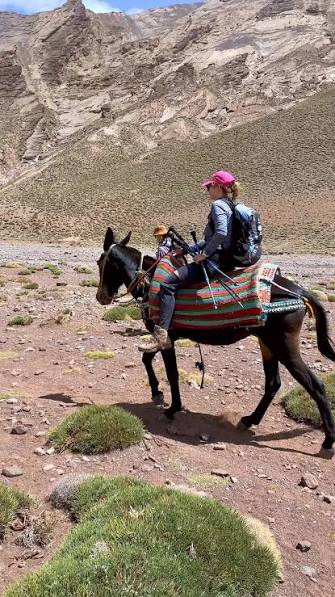
Travellers change how animals are treated by noticing. Here is what good practice looks like on an Atlas trek, and what to ask before you book.
Why this is a traveller's question
Trekking demand shapes how many animals work, how hard, and for whom. When travellers ask about loads and rest, operators answer — and when nobody asks, the cheapest arrangement wins.
This article is about what you can reasonably observe and ask. We are a trekking operator, not a veterinary authority, so nothing here is medical advice.
What good practice looks like
A well-run mule operation is visible at a glance. Loads are balanced left and right and tied so nothing swings. Tack sits on padding rather than directly on bone, with no rubbing at the withers or girth. The animal is not being pulled uphill faster than it wants to walk.
Through the day there are stops in shade, water where water exists, and an unloaded rest at the overnight stop. A mule that is standing loaded for hours while people eat is not being rested.
What to look at, honestly
Condition rather than beauty: an animal in work is not a show animal. Look for open sores, especially under the saddle area and around the girth; for hooves that are cracked or badly overgrown; and for obvious lameness.
If something looks wrong, say it to your guide during the trek rather than in a review afterwards. On our treks that conversation reaches the muleteer the same day.
What we do, and what we do not claim
Toubkal Views treats mule welfare as part of running a mountain operation: our position is that working animals should be treated with care and respect, not as equipment, and that this applies on every day of a trek and not only when guests are watching.
We also cooperate with SPANA's animal-welfare work for working animals in the Imlil area. What we do not claim: veterinary certification, a maximum-load standard, a mule-to-group ratio or a published veterinary schedule. Those are real questions and we would rather answer them once we can evidence them than publish a comfortable number.
Questions worth asking any operator
How many mules travel with a group of our size, and who loads them? Are the muleteers employed by you or subcontracted, and how are they paid? What happens if an animal goes lame mid-trek? Is there a limit on what a single mule carries?
An operator that answers specifically is telling you how it works. An operator that answers with reassurance only is telling you something too.
Veelgestelde vragen
- Can I refuse to have my bag carried by a mule?
- Yes. Tell us when you book and carry your own load. It does not change how the trek is run, though it does change what you can bring.
- What should I do if I think an animal is being mistreated?
- Tell your guide at the time, with the detail you saw. It is far more useful during the trek than afterwards.
- Does Toubkal Views have veterinary certification for its mules?
- No. We do not hold or claim veterinary certification, and we will not publish a welfare standard we cannot evidence.
Klaar om je reis naar Marokko te plannen?
Stuur ons je reisdatums en bestemmingen. Wij reageren snel met de beschikbaarheid, een prijs voor jouw groep en een duidelijk reisvoorstel.