Trekking
Trekking with a Local Guide in the High Atlas: What Actually Changes
8 de setembro de 2026 · 9 min read
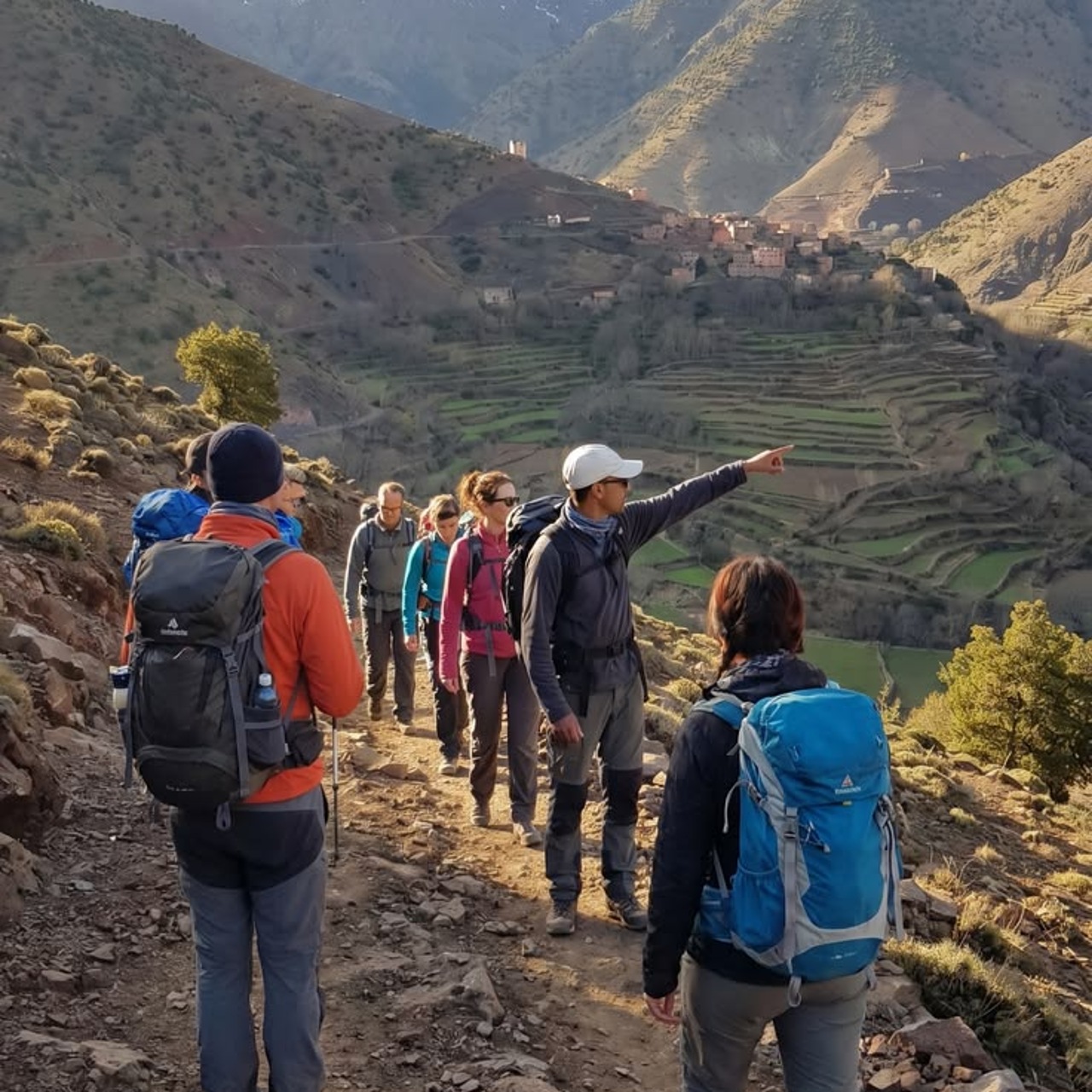
Not a safety lecture. A practical account of what a local guide changes on an Atlas trek: route judgement, language, village access, food, mules and pace.
The short answer
A local guide does not mainly make an Atlas trek safer in the dramatic sense. Most of what a guide changes happens long before anything goes wrong: which valley you walk on which day, where you eat, whether you can speak to the people whose village you are crossing, how heavy your pack is, and how fast you climb.
On Toubkal specifically, a guide is also the person who reads conditions in the morning and says the honest thing — that the summit is fine today, or that it is not. That single judgement is worth more than any equipment list.
Route judgement changes day by day
The High Atlas is not one path. Between Imlil, Azzaden, Tacheddirt and the Ouanoukrim side there are dozens of linked valleys, and the sensible choice on a windy October morning is different from the sensible choice in April meltwater. A guide who lives in these valleys is choosing between options that never appear on a downloaded route file.
That is also how a trek gets rescued rather than cancelled. If the summit is out, a good guide already knows which lower col still gives you a real day.
Language and village access
Most conversation in the mountain villages happens in Tachelhit, not French and not English. A guide from the area is the difference between walking past a village and being in it: tea in a house, an explanation of why a threshing floor sits where it does, permission asked properly before a photograph.
This is the part travellers remember, and it is the part that cannot be replicated by a map application.
Logistics you stop carrying
A guided trek moves the weight problem off your back. Mules carry the bulk between overnight stops, meals are cooked rather than rationed, and the refuge or village house is arranged before you arrive rather than negotiated when you are tired.
Toubkal Views works with more than 15 accredited guides across these valleys. We do not publish individual licence numbers or personal qualifications, because we only publish what we can evidence — but the network is why we can put the right person with the right group rather than whoever is free.
How to tell a good arrangement from a cheap one
Ask three questions before you book anything, with us or with anyone else. Who exactly is guiding, and are they from the valleys you will walk? What happens to the itinerary if conditions turn? And how are the mules and muleteers paid and loaded?
An operator who answers those clearly is telling you how they actually work. An operator who answers only with a price is telling you something too.
Perguntas frequentes
- Do I legally need a guide to trek in the High Atlas?
- Requirements differ by route and season, and Toubkal has its own rules. We keep that question in one place rather than answering it twice: see our guide on whether you need a mountain guide for Toubkal.
- How many guides does Toubkal Views work with?
- More than 15 accredited guides. We do not publish individual licence numbers, authorities or personal qualifications, because we only publish facts we can evidence.
- Can I hire a guide for a single day?
- Ask us on WhatsApp with your dates and the valley you have in mind. We will tell you what we can arrange rather than promise availability in advance.
Pronto para planear a sua viagem a Marrocos?
Envie-nos as suas datas e os locais que quer visitar. Responderemos com a nossa disponibilidade, o preço para o seu grupo e um plano detalhado.