Morocco
Aït Ben Haddou, Morocco: Visitor Guide, History & Things to Do
September 27, 2026 · 9 min read
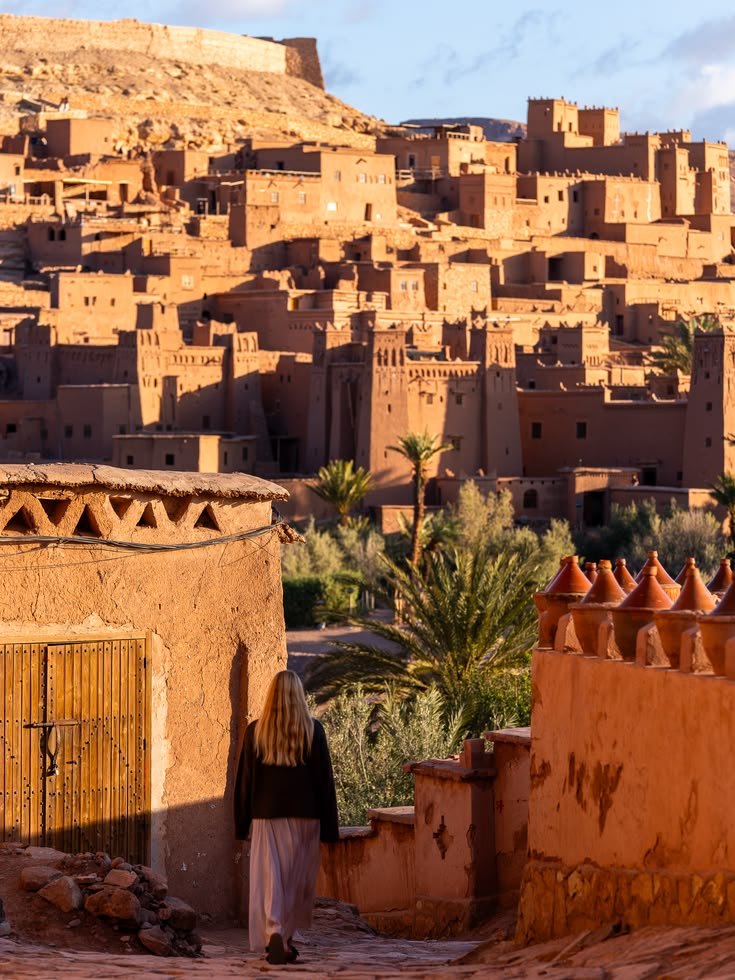
Beyond the famous earthen skyline is a place travellers often rush through. Understanding what Aït Ben Haddou is before arriving changes what you notice when you get there.
What is Aït Ben Haddou?
Aït Ben Haddou is a fortified earthen village — a ksar — on a hillside in the province of Ouarzazate, southern Morocco, on the southern side of the High Atlas. UNESCO inscribed it as a World Heritage Site in 1987 as an example of the traditional earthen architecture of the pre-Saharan south.
Ksar or kasbah?
The two words are often used interchangeably, including on signposts, but they mean different things. A kasbah is a single fortified house or residence, usually with towers. A ksar (plural ksour) is a whole fortified village: many houses, lanes and shared buildings enclosed by walls. Aït Ben Haddou is a ksar that contains kasbah-type buildings within it — which is why you will see it called both.
History in context
The ksar grew on the caravan route that linked the Sahara with Marrakech across the High Atlas. UNESCO notes that its oldest surviving buildings are not thought to be older than the 17th century, although the site and its style are older traditions. Because earthen buildings need constant upkeep, what you see is a continually repaired place rather than a frozen ruin.
Few families still live inside the old walls; most of the village's daily life is now in the newer settlement across the river.
Architecture: what to look for
Everything is built from earth. Walls taper as they rise, towers stand at the corners of the larger houses, and the upper parts carry decorative patterns cut into the clay. At the top of the hill is the collective granary, traditionally used to store the community's harvest.
Look at the details on the way up: carved wooden doors, crenellated wall tops and the way houses step up the slope so each looks over the next.
The landscape around it
The ksar rises above a river and a thin green strip of palms and gardens, with dry hills behind. That contrast — green valley floor, earthen village, bare slopes — is what makes the silhouette so recognisable from the far bank.
Things to do at Aït Ben Haddou
Cross the river and walk up through the lanes; climb to the granary for the view over the valley; step back to the far bank to see the whole ksar at once; and spend time in the lanes rather than only at the viewpoints. Craft stalls line parts of the route.
Photography considerations
Early morning and late afternoon give the warmest light on the earthen walls; midday is flatter and busier. The classic full view is from across the river. Always ask before photographing people, and respect doors and courtyards that are private homes.
Visiting responsibly
This is a lived-in heritage site. Keep to paths, do not climb on walls — earthen structures are fragile — dress modestly, carry your rubbish out, and buy from local stalls if you want a souvenir rather than bargaining aggressively.
Getting there and planning nearby
From Marrakech it is roughly four hours by road over the Tizi n'Tichka pass; Ouarzazate is about half an hour away. Most travellers either visit on a long private day trip from Marrakech or stop here at the start of a multi-day route towards the Sahara.
See it for yourself
Price is per person. The direct price is taken from the same product record as checkout, which recalculates it server-side.
Frequently asked questions
- Is Aït Ben Haddou a kasbah or a ksar?
- A ksar — a fortified village of many earthen houses within walls. It contains kasbah-type fortified houses, which is why both words are used.
- Where is Aït Ben Haddou?
- In the province of Ouarzazate in southern Morocco, south of the High Atlas, about half an hour from Ouarzazate and roughly four hours by road from Marrakech.
- Is Aït Ben Haddou a UNESCO World Heritage Site?
- Yes, inscribed in 1987.
- When is the best time of day to visit?
- Early morning or late afternoon, for softer light and fewer people.