How to Choose a Trekking Guide in Morocco
Practical criteria for choosing a High Atlas trekking guide: accreditation, local knowledge, honest route advice and how the mules and logistics are handled.
Choosing a guide in Morocco is less about finding someone who knows the path and more about finding someone who will tell you the truth about your plan. The trail up Toubkal is not hard to follow in good weather. The judgement calls around it — weather, altitude, pace, whether your group should turn around — are what you are actually paying for.
Start with accreditation, then keep asking
Morocco has an accreditation system for guides, and a working guide should be able to say clearly what they are accredited for. Ask. A guide who is comfortable answering that question is usually comfortable answering the harder ones too.
Accreditation on its own is not the whole picture. A guide accredited for cultural city work is not automatically the person you want on a snow slope at 3,800 m. Match the person to the terrain and the season.
The four questions that tell you most
"Have you done this exact route this month?" Conditions in the High Atlas change quickly between March and June, and again from November. Recent, specific experience of your route beats general experience of the range.
"What happens if the weather turns?" You want a plan, not reassurance. Good answers involve alternatives — a lower valley day, a delayed summit push, a different night in the refuge.
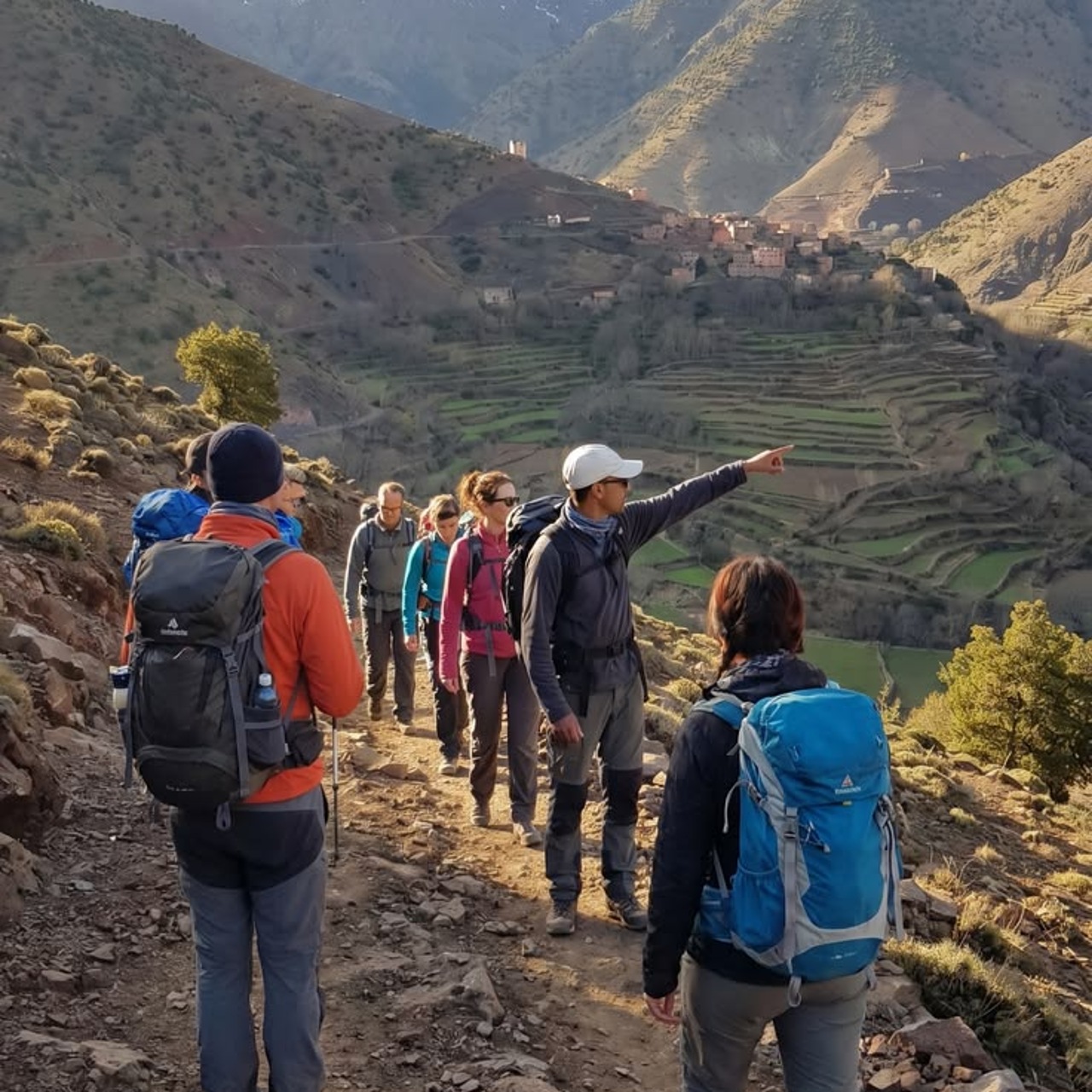
"How big is the group, and who else is on the team?" On multi-day treks you are usually walking with a guide, and supported by muleteers and often a cook. Knowing who is actually coming avoids surprises.
"Who handles the mules, and how are they treated?" This is a fair question and a revealing one. Mules carry the loads on most High Atlas routes. An operator who has thought about their condition, loads and rest has usually thought about the rest of the operation too.
Local versus remote operators
Plenty of Toubkal treks are sold by companies that subcontract everything on the ground. That is not automatically bad, but it adds a layer between you and the person making decisions on the mountain. If a problem appears at 3,200 m, you want the decision-maker to be the company you booked with.
How we work
Toubkal Views works with more than 15 accredited guides, most of them from the valleys around Imlil and Marrakech. Our two founders work in the field alongside them. We also run our own mountain-equipment operation in Imlil and our own mountain accommodation, Afla Sky Views — which mainly matters because it means fewer handovers when something needs fixing.
We are not going to promise you a summit. Weather and altitude do not negotiate. What we can promise is that the person walking with you is local, accredited, and paid to make honest calls rather than to keep a schedule.
Before you book
Read the route description carefully and check it matches your fitness and your dates. If a company cannot explain why the itinerary has an acclimatisation night, or why winter needs different equipment, that is worth noticing.
When you are ready, message us with your dates and we will tell you honestly which trek fits — including when the answer is a shorter one.
Frequently asked questions
- Do I legally need a guide to trek in the High Atlas?
- For Mount Toubkal a guide is required in practice and strongly advised generally. For lower valley walks around Imlil the situation is more relaxed, but a local guide still changes what you see and understand.
- How many guides does Toubkal Views work with?
- More than 15 accredited guides, most of them from the valleys around Imlil and Marrakech.
- Can I meet or speak to my guide before the trek?
- Yes. Message us on WhatsApp with your dates and we will tell you who is likely to lead your trek and answer route questions directly.